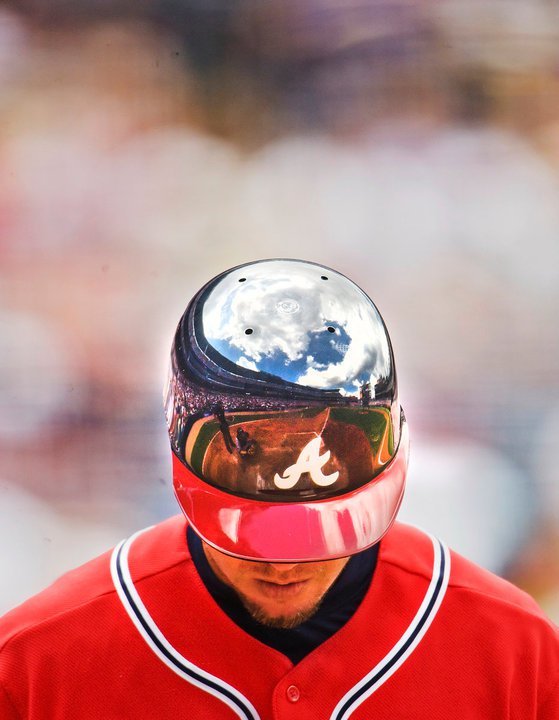
What if I told you there was a third basemen in 2011 that had more homers than Youkilis and Michael Young, a higher batting average than Evan Longoria, a higher on-base percentage than Beltre, and was second in all of baseball in fielding at his position; would you take him in 2012? 

Apparently many fans are scoffing at the notion that Larry Wayne “Chipper” Jones would consider playing past the 2012 season. He deserves more than that; especially considering he made his seventh All-Star game in 2011 and was undoubtedly the only Brave producing down the stretch last season. I’ll take those numbers out of a corner spot anytime.  

Chipper Jones is entering his 19th season with the Atlanta Braves. I grew up watching the greatest switch-hitter since Mickey Mantle everyday, and while this may be his last season in 2011 ( .275/18/70 and an All-Star nod) still has something left in the tank. Here’s to a productive and healthy 2012 Chip. 

The Atlanta Braves are content with their farm system and with good reason. Having placed five players on MLB.com’s Top-100 prospect list they future is bright. A lot of attention is going to be focused on shortstop this season as the Braves are giving the first crack at the job to Tyler Pastornicky who came over from Toronto in the Yunel Escobar trade. First impressions from the video above shows a swing that is a little too long and some hitches that may cause that. Outside of that he has good speed and should slip in nicely at the eight spot to generate some runs at the bottom of the order. 

The “Steroid Era” Cost A Generation Pure Baseball

Have you ever spoken to an older baseball fan about the game? Take a moment and listen how they speak about the players of “their generation.” The reverence someone who grew up in the 1950’s had for players such as Mickey Mantle, Duke Snider, Willie Mays and Jackie Robinson. Look ahead to the 1970’s and you hear of the beauty of the game played by Mike Schmidt, Reggie Jackson, Joe Morgan and others. That doesn’t even begin to describe how they speak about such legends as Hank Aaron, Ted Williams, Roberto Clemente, Lou Gehrig and Babe Ruth. Those were history makers and the general public saw that. I grew up in a neighborhood where my neighbor made it to a big league camp as a pitcher and he talked to me about his competition that spring in Indians camp. He described one player in particular who had “one of the best fastballs he had ever seen.” That man was Bob Feller. He “wisely chose a career in the military” he would tell me; just one of the many examples of stories from the past. That generation was privileged (some) to play against and see these extraordinary baseball players play and knew that when they were finished they would take their place among the other legends in Cooperstown.

There was no doubt. There were no arguments.

I was born in 1984. That year the Tigers were the toast of Baseball and the game was still relatively innocent. I began my interest in the sport in 1989 (coincidentally my first team was the Tigers) and that year would be significant. You see, that year, the Oakland Athletics were the best team in baseball. Led by two young mashers that fascinated the sports world in ways one could never imagine. Those sluggers were Mark McGwire and Jose Canseco. At one point in their careers when spoken of they were considered the best players in the world. Their names would have a different significance years later. 

In 1990, a young superstar was blossoming before the nations eyes in Pittsburgh Pennsylvania. “The Modern Day Clemente” was just one of the many labels placed on this 25-year old left fielder, whose father made a pretty good name in the game of baseball in his own right. Barry Bonds, son of Bobby and godson to Willie Mays, started his prime years by not only making his first All-Star team but also winning the first of seven National League Most Valuable Player awards. He would go on to break the most storied record in American sports history. Yet the American public would have more doubts and questions about his personal dealings than adoration regarding his accomplishments.  

Some years before, almost running parallel to the young superstar in Pittsburgh, was a young Texan by the name of Roger Clemens who began his career the year I was born. He started in Boston, where he would lead the Red Sox to the 1986 American League pennant with a Cy Young campaign. He set a record for strikeouts in a game that season with 20 against the Seattle Mariners. Ten years later he duplicated that feat against the Detroit Tigers in his last season in a Red Sox uniform. He would have a career renaissance in Toronto the next season that, in most cases, would seem like a man vindicated in proving the naysayers in Boston wrong for casting him aside like a 33 year old pitcher in decline. Now we look back and wonder if they were they right all along?

Baseball is a game that because of its history is special. Debating and discussing historical topics in baseball is a way of life for fans; whether they are a purist of the game or otherwise. I get envious when I talk to people who saw the greats play because they do it without a hint of doubt that it was done the right way. They speak of Hank Aaron knowing that every one of his 755 home runs cleared ballpark fences aided only by his strong hands and wrists. When they talk about Sandy Koufax and his blistering fastball and knee-shaking curve they know they saw a man who truly gave all that the good lord was willing to grant him until an arthritic condition pushed him out of the game. 

This is why we should feel cheated. I’ve spent a long time wondering why these and others deciding to cheat themselves out of honest and productive careers should matter to me. But as time goes on and it comes time for some of those names to be up for consideration for Cooperstown I realize exactly why it should matter. When I talk about some of the legends that have put up record-breaking numbers from my generation there is skepticism. Every time I mention a name from my era I have to preface it with “if he did it clean.” Historians will look at the time when I was a kid growing up watching baseball and point out that our best pitcher and hitter could both miss out on the hall of fame because they cheated. They will look at the modern day single-season home run leaders and scoff at their accomplishments; most notably because one of them at the top of the list has admitted to doing it the wrong way. They will also consider some of them a clog on the hall of fame ballot, keeping honest players from getting their just recognition.

It’s a shame, really.

But I still have players I can look up to. Tony Gwynn was the smartest hitter since Ted Williams and I’m able to debate that confidently. The most cerebral pitcher spent the majority of his career in my home state of Georgia and I feel lucky to have been able to watch Greg Maddux pitch every five days. Of course the two guys that followed him, Tom Glavine and John Smoltz, weren’t second fiddles by any stretch. I also can look at Cal Ripken, Jr. and not feel wary. Chipper Jones and Derek Jeter, who are two modern day ambassadors for their leagues, are still putting up numbers, but doing so gracefully with age.

It’s funny how it plays out, life. Looking back again, I began following baseball in 1989, which was the year the Oakland Athletics won the World Series behind those aforementioned mashers. In 1990 the Athletics, led again by McGwire and Canseco, made it to the World Series but were swept by an underdog Cincinnati ball team in a matchup labeled “David vs. Goliath.” A 26-year old future hall of famer who would be inducted in 2012 led that team. His name synonymous with the legends we speak about with such reverence but this time he is a representation of my generation. That player?

Barry Larkin.

 You see although we feel cheated, we can still take solace in the fact that clean always wins out in the end. While Barry Larkin was inducted into the hall of fame the others are still pleading their case through court systems and with the writers who vote on such matters. There should be no exceptions, and I don’t believe in such a stipulation as the “steroid era.” 

They cheated us out of an opportunity to speak of them as true legends without a hint of doubt. It is only fair they be punished for doing so. 

Washington Nationals Quietly Putting Together A Contender

We’ve all joked about them before. Either because you live in the DC/Metro area or because you remember them as that team who spelled their names wrong on their jerseys. You poked fun at them for finishing dead last and playing the kind of baseball that makes you wonder how on earth this team is still in the league. How bad was it? Baltimore, a team that hasn’t been competitive in their own league for 15 years was considered the big brother of the beltway. That is how bad it was, folks.

The Washington Nationals were the very definition of a joke. I remember the punctuation on that sentiment, for me, was a game I attended back in 2007 at RFK when the Nationals still considered it home. They were playing the Detroit Tigers who had gone to the World Series the year before but were showing signs of scuffling heading into the All-Star break. They lost 15-1 and I’ll never forget the two thoughts I had as I left the stadium.

RFK should never be considered a baseball facility, and the Nationals will never contend for anything besides best between inning entertainment.

Then came 2008.

Nationals Park opened and was a very exciting achievement. They played the Braves on opening day and won it on a walk-off home run by their franchise player Ryan Zimmerman. From there things began looking up for this franchise. A lot can happen when you get a new stadium. A lot can also happen when you string together a few bad seasons. You can supplement that new stadium with a few number one picks such as Stephen Strasburg and Bryce Harper. Then when revenues come in from the new park you can start adding pieces like Jayson Werth (although he is overpaid). You have to have people who know what they’re doing as well right? Enter Stan Kasten, Mike Rizzo and Davey Johnson. Now you have the makings of something special.

Rumor has it the Nationals are the front-runners to acquire Prince Fielder. If this happens two things will be true. Miami’s move will be nullified by this one signing (and trade of Gio Gonzalez with the impending arrival of Bryce Harper and return of Stephen Strasburg) and Washington will have the best top to bottom lineup in the National League. Can they win their division? I don’t see it just yet with the Phillies, although old, still bringing their rotation to town and the Braves, despite their collapse, putting together an impressive young nucleus of their own. Washington stands at the time to be the beneficiary of an expanded playoff courtesy of the new CBA ratified at the end of last year. if rumors are true of the set up I would not want to see one of their top three starters in a one game playoff to decide if I move on. 

That 2008 season a buddy of mine took me to a game and we sat field level next to the dugout of the Braves (Braves won that game). I remember thinking to myself how different the atmosphere was from the game I attended the summer before. The stadium was beautiful and everyone seemed to be enjoying themselves. It is a testament to how quickly things can change for a franchise. If the rumors are true, and Prince Fielder does sign on to join the Nationals the landscape of the National League East will change just as quickly. 

Albert Pujols Agrees to Contract With Anahem Angels; Sign C.J. Wilson As Well (Updated)

As reported, Albert Pujols has agreed to a 10-year/$260 million dollar contract with the Angels on Thursday marking the end of his St. Louis Cardinals playing career. Pujols, who helped lead the Cardinals to an improbable World Series run in 2011, was granted a full no-trade clause in the contract. 

During his time in St. Louis Pujols, 31, won three National League MVP awards and made nine All-Star appearances. He appeared in three World Series (2004, 2005, 2011) winning two of them and becomes the third contract in MLB history worth more than $200 million dollars (Alex Rodriguez twice). 

Pujols leaves a St. Louis team still loaded with talent in a lineup that includes Lance Berkman, Matt Holiday and Yadier Molina. There are rumors that the Cardinals could turn their attention to Prince Fielder to fill the void at first base. While Fielder may be limited athletically at first, his production is right on par with Pujols plus he makes the Cardinals younger so it would make sense to sign him to possibly fill that void. While replacing the best player in the game isn’t easy the Cardinals have the pitching and veterans to weather this if Fielder were to become their primary target. 

Meanwhile the Angels know what they’re getting.

Gold Glove caliber defense at first, coupled with a middle of the lineup threat the likes they haven’t seen since Reggie Jackson. While that is no knock on Troy Glaus, Pujols, who has averaged a line of 42/.330/119 since 2003 doesn’t appear quite ready to slow down and is a far superior hitter. This also puts him (if they chose to do so) between Kendry Morales, who will surely become the designated hitter unless they trade him, and Torii Hunter. It also helps that towards the back end of the contract Pujols can DH and be spared from fielding everyday in the American League. Assess that with the top of a lineup that will include Howie Kendrick, super prospect Mike Trout and Peter Bourjos and you have the makings of the ideal set up for Mike Scioscia.

The Angels also find themselves in the enviable position of having trade chips. The outfield (Vernon Wells, Bobby Abreu, Peter Bourjos, Mike Trout, Torii Hunter) is crowded, and there are no shortage of teams looking for outfield help in the speed and power department. One potential match could be the Braves who have the pitching (Jurrjens, Minor, etc.) to be able to offer the Angels an attractive package for an outfielder like Bourjos, who can play all three spots and could be seen as a replacement in the off chance Michael Bourn Doesn’t sign an extension.

As contracts go, spending $260 million dollars usually doesn’t sound like a win, but this puts the Angels in a prime position to take down the Rangers who staring the loss of another top-flight pitcher in C.J. Wilson right in the face. St. Louis, if they sign Fielder, will be okay. If not they have a void that won’t even be able to be minimized. 

UPDATED: C.J. Wilson Agrees to five-year $77.5 Million

On a day when they signed the biggest offensive fish in the pond, they turned around and signed the pitching gem of the offseason. C.J. Wilson reached a five-year/$77.5 million dollar deal with the Angels. These deals make them the no doubt favorites in the West. Texas, for the second consecutive offseason, lost a prized left-hander to free agency but this one is more damaging because he left to a division rival. 

Wilson, who went 16-7 with a 2.94 ERA last season, brings a third ace to a rotation that already includes Jered Weaver and Dan Haren. The top three in the rotation stack up with the best in either league. 

Meanwhile Texas, who has made back-to-back world series appearances will have to rely on Neftali Feliz a smooth transition to starting. They may look harder at trade options considering they will need someone to shore up their rotation in case of a set back to any of their remaining starters. Texas has the farm system to make a move, but Nolan Ryan, the clubs president, is reluctant to deal unless he knows they will get immediately better. The Rangers have been rumored to also be in on the Fielder talks and if added would have a power hitting first basemen available to a club that needs it in return for pitching. 
Fred McGriff Is A Hall of Famer Of The No Doubt Variety

When I was younger, growing up in Savannah, Georgia, I remember being glued to Atlanta Braves baseball from the age of six. That year was 1990, and as has been well documented the next year started an unprecedented run of division success in Atlanta that has made it the brand it is today. Sprinkled in were the opportunities to watch legends at work. I watched Steve Avery define what is now consider the blueprint for developmental pitching success. I witnessed Greg Maddux, Tom Glavine and John Smoltz win six of the decades Cy Young awards (Maddux won one his last year with the Cubs) and it was all surrounded by the arrival of an Atlanta sports icon in Chipper Jones, five national league pennants and the 1995 world series championship. Quietly, though, from 1993 to 1997 the Braves ran out another hall of fame caliber player that many seem to overlook outside of the city of Atlanta.

The “Crime Dog” Fred McGriff. 

I’ll give you a minute to poke fun before I produce some statistics that will no doubt solidify his case as a no-doubt-about-it hall of famer. 

Lets start with the years 1988 to 1994 when McGriff hit 30+ home runs each of those years, including two years during that stretch where he led the American and National League in that category (one of three in major league history to accomplish this feat). In 1994 he was robbed of an historic season when he finished with 34 home runs and a .318 batting average before the strike hit. He did however win the All-Star game MVP that season.  

McGriff was more than a masher, finishing his career with a .284 batting average over 19 seasons. He defined the role of the prototypical clean-up hitter because he blended power and average so well hitting .300 or better in five seasons, .290 or better in two seasons and .280 or better in four. In 1995, when the Atlanta Braves won their only world title, McGriff lead the way with 27 home runs. 

He was a five-time All-star and finished in the top-10 in voting for the MVP six times. Now I know what you’re saying right now is where is he in an historical context? 

I’m glad you asked. 

Baseball Reference has him comparable to Eddie Mathews, Billy Williams, Willie Stargell, Willie McCovey and Jeff Bagwell. By my count that is four current and one future hall of famer. His 493 (untainted) home runs place him 26th all-time in baseball history and tied with Lou Gerhig. Most importantly, though, his dominance during his early years and well into (and even past) his prime made him an incredibly influential player because the model by which a clean-up hitter is measured was, and to some extent still is, Fred McGriff. If for nothing else his consistency alone made him invaluable to every club he played on. His 15 consectuve seasons with at least 20 home runs leaves him as one of 14 players in history to accomplish the feat. Add to the fact that McGriff played the game the right way and was known as a “great guy, better teammate” in every circle and you’ve got a baseball writers dream candidate for enshrinement in Cooperstown. 

Of course my favorite thing about Fred Mcgriff will always be that swing.

http://mlb.mlb.com/shared/flash/video/share/ObjectEmbedFrame.swf?content_id=13081181&topic_id=&width=400&height=254&property=mlb